



As you may have seen elsewhere I have finally been motivated to pick up a project that I first took interest in in 1972
 - it just goes to show that 'it's never too late' but I admit this is stetching it a bit

Anyway it all began when the 1972 Feb issue of model boat magazine dropped on the mat. Featured inside was this absolutely enchanting steam launch and I was instantly smitten! I was, at that time, enjoying a short foray into powerboating from previously a total dedication to aeromodelling and it would prove not only the catalyst for my subsequent journey into model engineering but consequently a career change to boot but thats' another story.
Wide a Wake was a clinker (lapstrake) built boat powered with a Stuart Turner Double Ten engine. Designed by Howard Croker, an Australian I believe, it's appeal was that it was built exactly as a full size boat plus of course it had a real steam engine in - something I was completely unaware existed at that time.
An engine was sought - I had no skills nor kit to make such - and after several calls to various model shops were made, all from the local village phone box, what sounded like a D10 was located in Roland Scotts of Bolton. Second hand the deal was done - a brand new water cooled Merco 61 IC engine was taken in direct exchange and the engine duly arrived
 - Well it worked but it did look in a very sorry state. Really dirty and painted in the most awful lurid, near luminous, green I stripped it down repainted it and rebuilt it to a more reasonable appearance.
The boiler was made, the shell material courtesey of an offcut from a local shipyard and with the help of a work colleague the boiler was made at work during an onshore lull. Unfortunately one of the water tubes has a slight leak so preventing a hydraulic test so neccessary today. Also the material that the dome is made from, though thought that it is possibly manganese bronze, could be brass. No knowledge of the dezincification process was known at the time and so it would be far to risky to chance so the boiler is due for a complete overhaul but more on that at a later date.
However the plant has sat waiting patiently since 1972
 ...

Materials were purchased at the time - copper nails and roves, brass screws, tubing for the propshaft etc followed a while later by the timber (Parana Pine) but nothing got done for as is the way of things events got overtaken by the desire to further model engineering skills. That first 'real' lathe was bought an ML10, quickly upgraded to an ML7, and the rest is 'as they say'.
About ten years ago the keel was cut out and the stem attached along with the moulds (shadows) but again nothing transpired until that is about twelve weeks ago when quite unexpectedly, but no doubt inspired by the two launches seen at Norwich, the urge was there - perhaps it really was finally time to seize the moment, after all it might not last for long

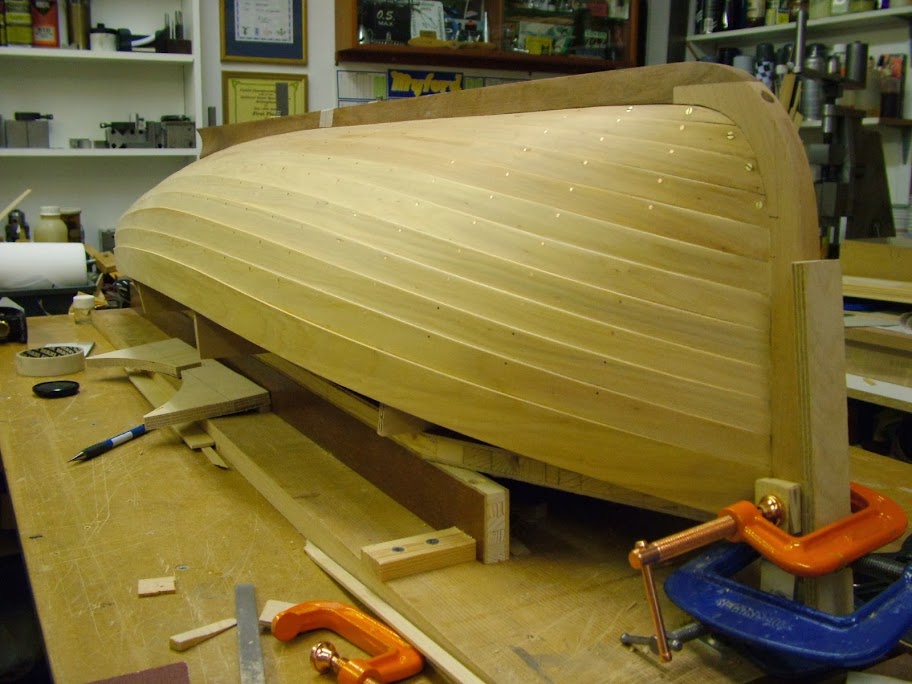
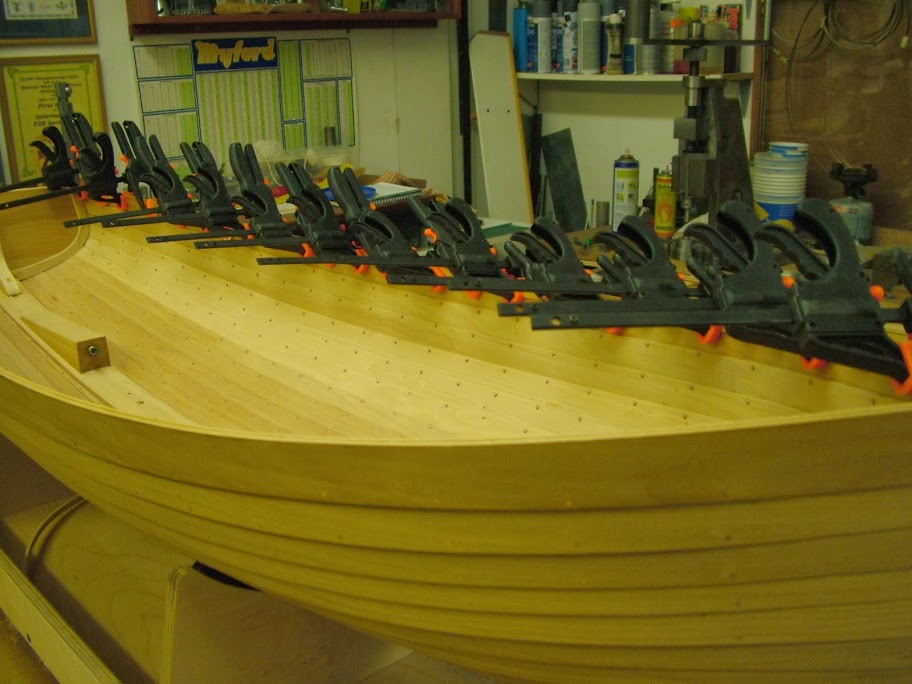
It's well underway at this point (sorry about the pun) but I'll post a few pics tonight and follow up with some more later if you deem suitable. I can say having now actually got a hull, it's proved to be an immensely satisfying thing to build - should have done it years ago
Some pics then...
First off was to square up the lower face of the keel - to the rear are the moulds fixed to a rigid base board

Then laminate the hog

Next was to drill out for the prop tube. This jig was made and two long series drills were used - 6.5 and 11.5. The first hole was drilled then the blocks opened up to take the 11.5 drill


Run out was a concern but very little -about .5mm over 200mm or so - occurred. That was trued up enough using a file to align the prop tube spot on.

The keel was then 'sided' (tapered) and the water ways cut in

With the shaft log and transom fixed in place along with the hog the keel assembly was held to the moulds using the transom, the stem and two small bolts through the keel into the shadows ready for the next phase - the planks.

I got about this far earlier and then lost it all by inadvertently hitting the back button so that's the lot for tonight - aaaagh - it's good to be back!
Regards - Ramon


 he'd bought a job lot of rejects


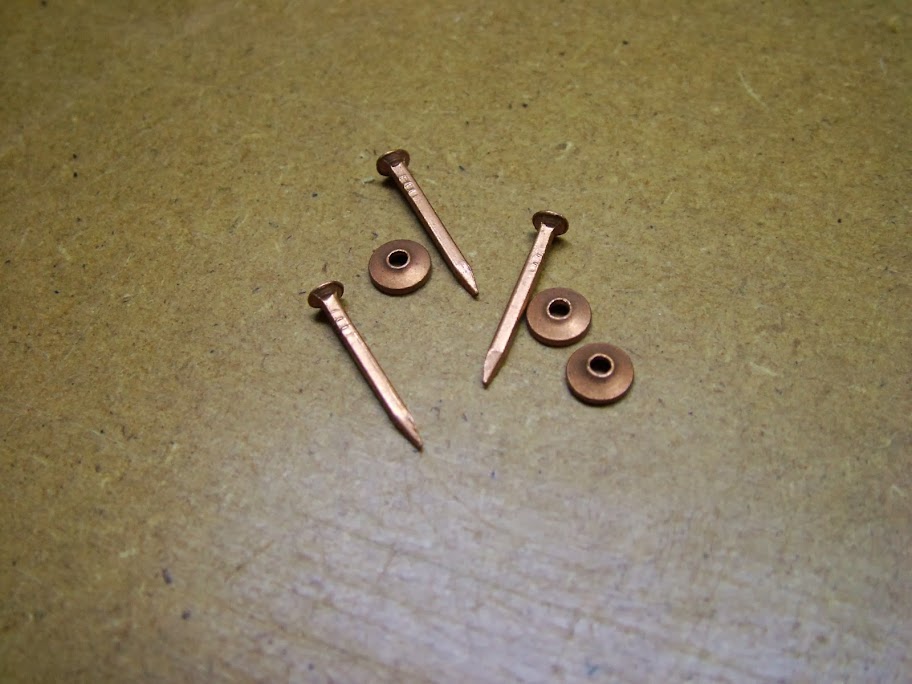


 For the first time then that home made fly-press actually got to work on a repetitive basis and produced several hundred of these little devils in 1/4, 38. and 1/2" lengths. The 'die' BTW, actually really an anvil, had a sprung loaded ejector below hence the rivets sitting proud

 at this point ...