




Four Stroke Diesel Revisited

Started by Roger B · 19 replies · 6,858 views

Minh Thanh
Reply #15 · 27 Sept 2026, 12:42
Quote from: Roger B

I turned the engine over to see if I had a chance of hand starting it (when warm) as Find Hansen did in this video as well as with one of his own engines. I felt from previous test runs of my engine that either Mr Hansen has a very strong thumb or his engines run with a lower compression ratio.


  As I mentioned earlier, there are many issues...
It is the same with the Chinese diesel engine he modified in the video. For a slightly larger engine, he has to use an exhaust extension to vent the fumes away from his workspace; he cannot make it run completely smoke-free like his other engines when using diesel fuel - But I'm not sure if he uses diesel fuel or...!!??
A gentle turn of the flywheel—less than a full rotation—is all it takes for the engine to start easily, and there is virtually no smoke during a cold start. I imagine many full-scale engine manufacturers—major diesel engine corporations—would want to buy that technology from him; he could likely make billions of dollars.
.......
A long time ago—over ten years ago—I watched a YouTube video featuring his engine being run on diesel by someone else; the results were completely different from the videos he had posted himself. I can't find it anymore; I really wish I had saved the video or the link.
Last edit: 27 Sept 2026, 13:11 by Minh Thanh
Admiral_dk
Reply #16 · 27 Sept 2026, 16:51
As far as I remember - Find Hansen has made a number of different designs - and I'm not talking about appearance ....
Again from memory  ::)  His true Diesels has a compression between 18:1 and 22:1 + he normally runs them on Kerosene, as this is much cleaner .... he stated that he has run the first ones on true Diesel Fuel - but prefer Kerosene.

He also has build a number of Hot-Bulb Engines and they run at a much lower compression (like the full size ones) and again on Kerosene.

Though I'm very impressed with his Engines - I haven't followed him enough, to know about more than 7 or 8 off them + a few videos about how he got them to work in the first place and what to be really careful about to have any success ....
The last probably about a year ago ....

Per      :cheers:
Roger B
Reply #17 · 27 Sept 2026, 18:50
Thank you both, I am not sure why I am not getting near Find Hansen’s results but I will keep trying  :headscratch:

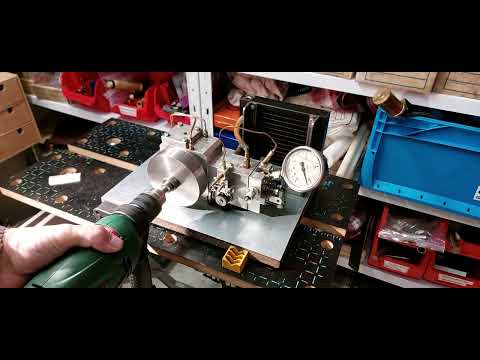
I checked the fit on the engine before tapping the holes M4. There is a pinch point between the flywheel and the base so I may have to add some thicker spacers under the engine.

The bush was then pushed out of the flywheel ready for slitting. After slitting the flywheel was mounted on a tapered mandrel between centres to lightly skim the rim. The faces seemed good enough.

https://youtu.be/fNqfV7xy5tM?si=ZLOPN9avwb1DTZjRYouTube video

I then fitted the assembly to the engine to see if the effect of the higher inertia was noticeable.

https://youtu.be/h6PbHTbLSas?si=s-VKEL_dii203KN1YouTube video

Cranking was much smoother and easier on my wrists. There was also a noticeable coast period  :)

For those who are new to this engine this is why it needs good ventilation:

https://youtu.be/nHYDfQaNw98YouTube video
Log in to see this image
Minh Thanh
Reply #18 · 28 Sept 2026, 02:59
Quote from: Admiral_dkAs far as I remember - Find Hansen has made a number of different designs - and I'm not talking about appearance ....
Again from memory  ::)  His true Diesels has a compression between 18:1 and 22:1 + he normally runs them on Kerosene, as this is much cleaner .... he stated that he has run the first ones on true Diesel Fuel - but prefer Kerosene.

He also has build a number of Hot-Bulb Engines and they run at a much lower compression (like the full size ones) and again on Kerosene.

Though I'm very impressed with his Engines - I haven't followed him enough, to know about more than 7 or 8 off them + a few videos about how he got them to work in the first place and what to be really careful about to have any success ....
The last probably about a year ago ....

Per      :cheers:


  With a compression ratio of 18:1 or higher, it is very difficult to turn the engine past the compression stroke; my engine has a 165 mm flywheel, and it is not easily done—unless I grab the flywheel and yank it with the full strength of my arm.
Auto-ignition points: diesel 210°C, kerosene 220°C.
"The auto-ignition point (or auto-ignition temperature) of a fuel is the lowest temperature required for it to spontaneously ignite in the air without any external flame, spark, or ignition source."[/size]
Do you think that just a slight flick of the flywheel is enough for the temperature inside the cylinder to reach 100 or 150  degrees Celsius ? Let alone reaching 210 degrees Celsius.
  The reason diesel engines require a high compression ratio is to raise the temperature of the compressed air to the point where the injected fuel can self-ignite.
All the model engines we build must rely on the mechanical principles of fullsize engines and the properties of the fuel.

  Perhaps I should build a four-stroke engine that doesn't require an ignition system. ;D ;D
Last edit: 28 Sept 2026, 03:16 by Minh Thanh
Roger B
Reply #19 · 4 Oct 2026, 15:12
Although I had a cranking compression pressure above 30 bar this dropped at low speeds and it was still possible to slowly ease the engine over compression. A check using a length of plastic tube as a stethoscope suggested a small leak past the inlet valve.

I removed the cylinder head again and took out the valves. The inlet valve looked OK but there were some markings on the valve seat. I gave the valve seats a clean up with the original cutter and lapped the valves with 5 micron diamond paste. After a wash in the ultrasonic bath I put it back together. There was no detectable leakage from the valves.

The compression is better at low speeds, however the inlet valve timing starts to have an effect as well. In the previous test it would reach 30 bar at around 1000 rpm, after lapping the valve 30 bar was reached at around 800 rpm. There is also still a small leak via the compression tester, either through the ball valve or one of the several joints.

https://youtu.be/GpMDgod9S0M?si=Zw0PC0jN3LD-2q6hYouTube video
Log in to see this image

Quick reply

Log in to reply.